
Every July, Disability Pride Month celebrates people with disabilities and recognizes disability as a natural part of human diversity. It is a time to honour the identities, experiences, achievements, and contributions of people with disabilities.
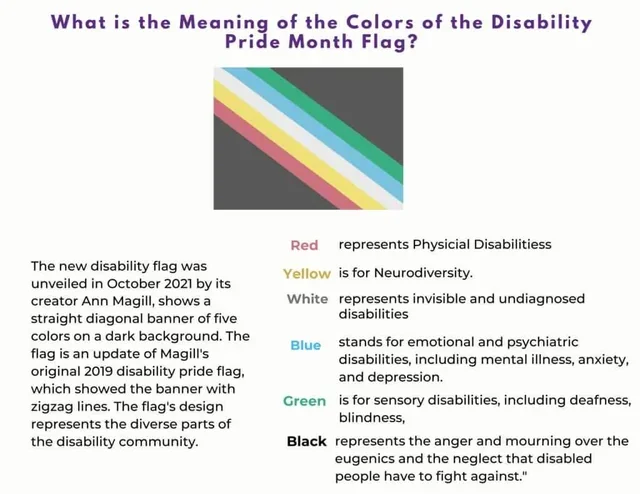
What Does Disability Pride Mean?
Disability pride challenges the idea that disability is something to hide, fix, or view only as a struggle. It recognizes that people with disabilities have different identities, strengths, talents, relationships, and ways of experiencing the world.
Disability pride does not ignore the challenges people may face. Instead, it recognizes that many challenges are caused or made worse by inaccessible spaces, unfair attitudes, communication barriers, and systems that do not include everyone.
Disability in Canada
Disability is part of life for many Canadians. According to Statistics Canada’s 2022 Canadian Survey on Disability, 27% of Canadians aged 15 and older—about eight million people—reported having at least one disability.
Disabilities can be visible or non-visible. They may also be permanent, temporary, or change over time. Disabilities can affect mobility, vision, hearing, communication, learning, memory, mental health, pain, flexibility, and other parts of daily life. Because each person’s experience is different, accessibility cannot follow a one-size-fits-all approach.
Moving Beyond Awareness
Disability Pride Month is an opportunity to move beyond awareness and take meaningful action.
Accessibility is about more than adding a ramp or meeting basic requirements. It also means making information easier to understand, offering different formats, removing digital barriers, creating welcoming spaces, and providing flexible ways for people to participate. Accessibility should be considered from the beginning, not only after someone experiences a barrier.
How We Can Support Disability Inclusion
We can all help create more accessible and inclusive communities. We can challenge ableist attitudes, respect individual communication and accommodation needs, and avoid making assumptions about what someone can or cannot do.
Organizations can also review the accessibility of their spaces, websites, communications, programs, and services. Accessibility is an ongoing responsibility, not a one-time task.
At Vibrant, we are committed to creating services and community spaces where people with different abilities, needs, and lived experiences feel respected, welcomed, and included. We will continue to listen, learn, and work toward a community where everyone can participate, connect, and belong.